
Wednesday, 30 October 2013
Illuminated Knight Character Design Concepts
As with every design I tend to go overboard with my research, once I've collected reference imagery it helps to take the best images and create a mood board of interesting styles that fit with your initial design concepts. From the storyboard and character bio I had created I already had strong ideas of the kind of character I wanted to create, a Teutonic Knight. I collected lots of different armour sets for my mood board but needed to keep the design consistant and historically accurate. The design I decided to choose copied a style in keeping with the period, but with the big horns on a Teutonic Knights helmet, gave my character design a strong silhouette.

Monday, 28 October 2013
Illuminated Knight Character Biography
As part of the character design stage and to help realise our characters we were given a worksheet to fill-in with our character biography. Doing this helps to fully visualise your character from it's traits, to where it lives, and what it looks like, but also how it may animate or react to a situation or environment.
Obviously I had to create a character that would fit with my storyboard, and my 'Illuminated Knight'/Stained glass window game design idea, but after completing this exercise I feel reading all of Game of Thrones last summer has had a little influence on my character....Gendry perhaps!
Character
Bio:
Age:
28-32
Profession:
Teutonic Knight/Mercenary/Crusader
Family/Friends:
None, Raised by a Blacksmith, sold to a wealthy knight to train as
his squire.
Goals/Ambitions:
Money/Glory/Recognition
Physical
Health: Broken, World Weary
Education:
Trained/Raised as a Squire, Swordsman, Smith
Sex
Life: Vow of Chastity
Values:
Just, Honourable
Weakness:
Age, Too Honourable, at the end of his professional life
Flaws:
Too old for his job
Environment:
Ecclesiastical
Culture:
Religious
Gender:
Male
Income:
As much as he can carry
Religion:
Christianity (Faith is wavering)
Hygiene:
Basic – Cleanliness is next to godliness
Morals:
Chaste, Pure
Intelligence:
Average – High, Cunning
Sense
of humour: Dry
Obstacles:
Birth rite
Talent:
Skilled, Swordsman, Cunning
Self
View: Harsh, Angry
Ethnicity:
White, European
Era:
Medieval
Dreams:
An End to violence, deal with personal demons, a quiet life, to
return home and live in peace
Diet:
Poor, Meager
Fears:
Persecution in the afterlife
Childhood:
Sold and raised by a blacksmith, taken on as a squire by the local
lord who noticed his talents
Character
Back story
Born
to a low wealth family he was sold to a blacksmith for a better life.
Forged by steel and fire, instilled with strong morals and a work
ethic, his talents at smithing gained the attention of the local lord
and was taken on as his squire. He was trained in pageantry, educated
in Latin and groomed to become a knight by the kindly lord. The lord
however died of the plague and our hero was stripped of his
bequeathed land and title by the lords extended family. Forced to
wander for years the knight did his best to uphold his morals and
fight injustice wherever he saw it. The land was cruel however and
our hero was forced to walk a thin line between good and evil. When
Richard the Third declared his crusade our hero signed up to escape
the despair sweeping through the land, prove his skills, and fight
for the chance of honour, glory, and riches.
Obviously I had to create a character that would fit with my storyboard, and my 'Illuminated Knight'/Stained glass window game design idea, but after completing this exercise I feel reading all of Game of Thrones last summer has had a little influence on my character....Gendry perhaps!
Friday, 25 October 2013
Illuminated Knight Storyboard
From my initial game design research I worked up a storyboard for an opening cinematic that would be a great introduction to the narrative for the player, and visualise the design concepts I wanted to convey.
Storyboard
Scene
1:
Interior
of a church, dark, dimly lit with a few candles on sconce’s and
chandeliers. The sound of a battle can be heard raging outside.
The
camera pans down the isle focusing on the walls, shadows of men
fighting dance across them, illuminated by the huge fire that engulfs
a nearby settlement. Cries of pain, steel clashing against steel can
be heard ringing from a thousand different sources.
Scene
2:
Bang,
Bang, BANG! The camera quickly turns to face the door as each bang
makes the door shudder. With the focus on the doors, they fling open.
A knight with head bowed holds them both open at arms length
silhouetted by the light of the burning city in the background.
Silhouettes of men fighting and dying in battle fade into the
distance as far as the eye can see behind the weary knight.
Scene
3:
Focus
on the feet of the knight as he trudges, wearily down the isle, pools
of blood congeal beneath every step he takes, each one seemingly
heavier and more painful than the last for the battle fatigued
warrior. The door creaks behind him and slams shut (off camera).
Gregorian chant can be heard softly in the background mixing in with
the sounds of battle.
Scene
4:
The
camera pans lazily with the knight, he surveys the windows of the
church as he walks revealing the rich stained glass that adorn the
walls (each window should be representative of a different level,
boss, or scenario within the game). The knight turns his head from
side to side staring in wonder at the rich artwork.
Scene
5:
The
knight flops down at the altar on his knees resting on his sword. Its
point digs into the stone floor as he rests both hands on the pommel
and his head on his hands, he begins to pray. As he prays the camera
rotates around to behind him and as he looks up the camera pans up as
well revealing a large stained glass window which depicts a galleon
on an ocean. Sounds of gulls can be heard at that moment, are they
outside? The galleon moved or is it a trick of the light?
Scene
6:
Focus
on the feet/legs of the knight the sound of glass tinkling on the
ground can be heard as a small blue, sapphire like gem, bounces into
frame and rests by the foot of the knight. With each bounce the gem
catches the light and sparkles (lens flare, and slow motion
perhaps?).
Scene
7:
The
knight picks up the glass shard gently between his armoured thumb and
forefinger and holds it up to the light of the altar window, rolling
it slowly as he does so (it catches the light again). Focus on the
gem, then focus on the window in the background, at the same time he
notices a small hole in the blue ocean of the stained glass.
Scene
8:
The
knight steps up and moves closer to the window. Focus on the hole as
he traces it with the tip of his mailed index finger. The Gregorian
chant begins to be heard more clearly over the noise of battle.
Scene
9:
Focus
on the feet of the knight as blue sapphires start to rain down around
them from the top of the frame. (Slow motion, hopefully done using
Realflow/Particle effects). Again each gem catches the light and
sparkles.
Scene
10:
Camera
behind the shoulder of the silhouetted knight, focus on the window as
it starts to crack and then explodes into a million pieces and roars
through the window like a burst dam. The knight is pushed forcefully
back out of the scene to the right. The music also picks up to a
crescendo.
Scene
11:
The
gems fill the church, the knight struggles but then is engulfed,
drowning in the sea of sapphires. The last thing we see is his hand
closing into a fist as the gems rise higher covering the frame of the
scene. The music dies.
Scene
12:
Black,
the sound of gulls and breaking waves can be heard. The scene starts
to resolve itself above a gently moving sea that appears to be made
of stained glass. A large shadow looms into the scene and the sound
of splashing oars can be heard. A hand plunges from the foreground
into the water and when it pulls back is holding onto hand of the
helpless knight.
Scene
13:
As
if the stained glass window has come to life, the galleon from the
previous scene is now gently rocking back and forth on the sapphire
waves. Crew members rush back and forth doing their daily duties, as
seagulls wheel and call in the air. One of the crew pulls the knight
aboard, he slumps down on his knees coughing, as the crew member pats
his back and the points to the left. The galleon slides gently left
and into a bustling port, as far as the eye can see a city of spires
stretches into the distance. Sounds of children playing, sellers
shouting, and dogs barking bring the scene to life.
Scene
14:
The
title screen pans in from the right 'Illuminated Knight', as clips form
different levels of the game flash onto the screen, hopefully this
will give the player the idea of what they can expect, but also act
as a game trailer/demo. It'll highlight the in game mechanics, glass
vs stone, ice, fire, sand, reflective puzzles (moving statues to
reflect light for puzzle elements), or overlaying different colours
of glass to create new colours
Monday, 21 October 2013
Brothers: A Tale of Two Sons. Game Mechanics Vs Narrative
What makes a game has been the subject of much debate recently with the argument torn between mechanic vs narrative. In my opinion it's game mechanics that make a game, where the narrative ties the mechanic together, the mechanic is what keeps a player coming back and adds replayablity to the product. There are plenty of examples of games that became wildly successful with no narrative to speak of, e.g Tetris, Pac-man, and more recently Minecraft. There are also examples of games that purely focus on the narrative and while they give the player the ability to choose their own path they offer little in regards to replayability, once the story is complete there is little more to experience bar a few slightly different scenes and endings, e.g. Heavy Rain, Dragon's Lair, even Modern Warfare to some extent.
Recently there has been a fusion of the two that marry both in the way no other media could do, I believe it is the next evolution of the genre, a perfect example of this would be Brother's: A Tale of Two Sons, created by Starbreeze Studios. Initially released for XBox Live on August 2013 the game follows the story of two brothers on a quest to cure their terminally ill father. Unusually the player controls both brothers on the the same controller, it may feel a little overwhelming at first but the game eases the player into the mechanics through a series of easy environmental obstacles. These mechanics tie beautifully into the narrative throughout the game as each brother reacts differently to context sensitive obstacles within the world, the player discovers more about each brothers individual personality naturally with this method rather than being told outright.
This fusion of mechanic and narrative becomes starkly apparent during the final levels as the older brother (SPOILERS) dies, not only does the player feel the loss of the brother through the emotional narrative that the player has been on but through the loss of control of the character. It's quite difficult to describe the feeling to someone who hasn't played the game but I can only describe it as phantom limb syndrome, having controlled both characters throughout the game, only controlling one feels extremely odd, this loss mirrors and enhances the narrative in a way I haven't seen before and has really inspired me. I believe this is the future of the genre and it's what sets games apart from any other medium.
Friday, 18 October 2013
Weekly Targets
- Create a biography for my knight character
- Write up the Storyboard idea for my opening cinematic
- Research armour designs for my character
- Create a mood board of armour sets
Friday, 27 September 2013
Box. Amazing 3D animation
Here's a great video using projection mapping on moving surfaces by The Creators Project, linked with the movements of the camera it gives an amazing 3D illusion.
Tuesday, 17 September 2013
Illuminated Knight Game Concept
Over the summer my brief was to come up with a variety of game ideas and choose one that could be worked on throughout my second year. I find I'm never short of ideas but the one i eventually chose had to be of sufficient scale to be worked on for the next few modules, bring together all the elements that I have learnt so far and expand/practise those skills, also, ambitious as it may sound, to try and do something unique and stand out within a saturated market place.
Next year we are going to see the long awaited return of virtual reality, with the arrival of VR peripherals such as the Oculus Rift and Sony's proprietary headset. I'm really excited as I remember the VR boom that happened in the mid-nineties but unfortunately the tech at the time failed to live up to expectations.With the raw processing power, increase in graphical fidelity, and parallel advances in mobile phone technology such as the miniaturisation of displays and accelerometers, the time seems right for VR to make a come back. The buzz around the Oculus Rift is very positive and it would be foolish to ignore the potential new marketplace, and the chance to pioneer new gaming experiences using the tech.
Developers such as Epic and Valve are already adding mod support for the Rift to their game engines, and CCP have announced their own standalone, space combat game, Valkyrie, where players dogfight in spaceships based around the Eve online universe. With that in mind in relation to my own game design ideas, I felt a first person, VR, horror game using the Unreal engine would be an ideal project. Horror games are pretty intense at the best of times I imagine with the added immersion of VR future horror games are going to have to come with a health warning! I thought an archetypal haunted house scenario would make a great setting for an early project but to make it more unique I wanted the artwork to reflect the cinematography of horror maestro Dario Argento. Italian film director Argento is probably best known for his work with George A Romero on the 'Living Dead' series but has also produced some cult classic horror films such as Susperia (a personal favourite of mine).
Susperia follows the story of a women who joins a convent but soon learns that it's actually a coven of witches. Whilst this would make a great narrative for a haunted house game it's more the way Argento uses colour to create mood within his films that I believe would make for a game with a unique style.

I envisioned a game where the player navigates around an almost pitch black environment populated with islands of colour. These would signpost the player through the levels and act as areas of safety, and discovery within the game. However, as Argento does in his films, the colour in the game would also help set the mood for the player, and eventually the darkness would become the players friend. Even though I believe this would make for a great experience, I'll have to wait to buy a VR headset to experiment with my idea.
Another idea I had over the summer, was based on Kerbal Space Program, the game gives the player a set of modular assets that can be combined together to create their own rockets, satellites and space vehicles. Once built the player can take their vehicle to the launch pad and try to get it into orbit. The gameplay comes not only from the fun of building but the realistic physics the game uses whilst launching a spaceship. It simulates the effects of gravity so the player must balance payload, fuel, centre of mass, aerodynamics, and structural integrity to achieve orbit. Many Kerbal's will die a fiery death whilst the player gets used to these mechanics but that's half the fun.
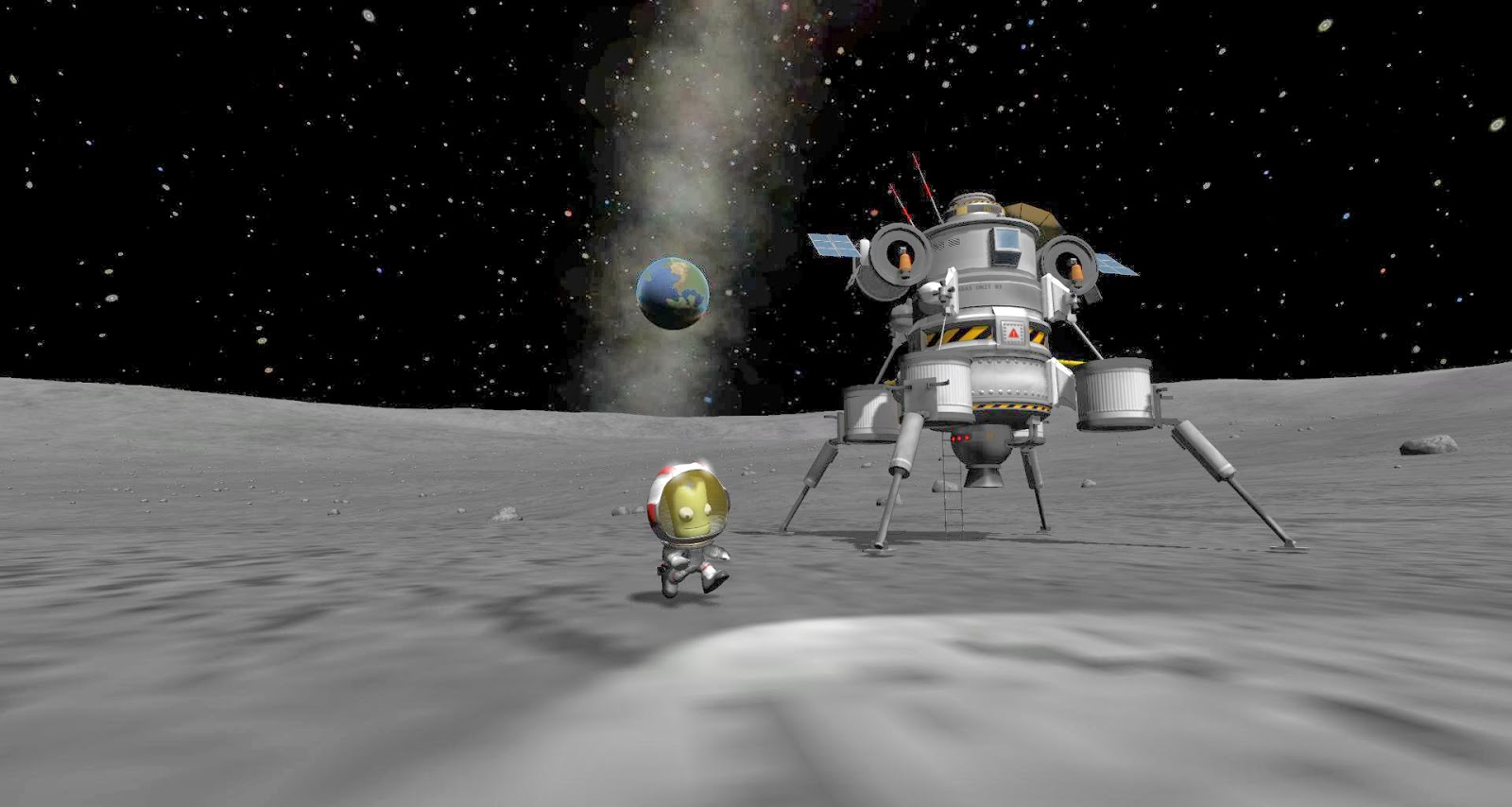
During my playtime with the game I realised this could be turned on its head, rather than exploring space, a similar game could be created that explores the deep sea. The player would be the head of a research/exploration company where they are given limited resources and modular assets to build submersibles. Quests would have the player plumb the bottom of the seas for salvage, rescue, and discovery, that will reward the player with cash, science points, and better submersible assets to use on increasingly challenging missions. As well as building vehicles the gameplay will come from the risk/reward of the pressure vs depth challenge that would come with each dive. The player would want to go that little bit deeper for more rewards or the chance to see/capture a unique species but with the added risk of the submersible imploding. I also thought this idea could incorporate the Oculus Rift, having the player pilot a submersible from a first person perspective with a VR headset would add a whole new level of immersion. Graphical effects such as glass cracking, emergency lights blinking, and strange fluorescent creatures that loom out of the darkness, would all add to this eerie sense of claustrophobia that I would want the player to feel.

I even started to model a very basic submersible that would act as a concept piece for the game idea. The submersible would be at the bottom of the sea surrounded by thermal vents with luminous, deep sea creatures hiding in the darkness around the vehicle, waiting to strike.
Even though this idea has a strong premise and unique gameplay it lacks narrative, and as I've discussed previously it's my opinion that a good game doesn't need narrative if it has unique mechanics, but I knew my upcoming modules would require a storyboard element, as I'm so closely tied to the animation department, so I've put this idea on the back burner for now. Seeing as the developers of Kerbal Space Program have embraced the modding community, I think this idea would make a great mod, rather than a standalone game.
I had another idea that sprang up from the haunted house theme that I'd researched. Dungeon Keeper created by Bullfrog in 1997 was one of my favourite games of all time. You played as an evil overlord and with the help of your imps you were tasked with building a functioning lair with amenities to attract more powerful creatures that would help you defeat the lord of the land, e.g building a graveyard would attract vampires to your cause.

It had a great art style and sense of humour, and is still one of the few games where you get to play as the 'bad guy'. Unfortunately Bullfrog lost their magic when Peter Molyneux left to form his own company, and the series has never been revisited. I wanted to use the Dungeon Keeper format, an isometric, strategy management game, but with my own twist. My game would be set in a haunted house, at the heart of the house would be the Necronomicon (Ala Evil Dead), you would build traps and summon minions to guard the house and its contents, however tonight is Halloween and all the local kids have dared each other to enter your domain and try to steal your source of power.

Structurally and tonally I'd like to think the idea lies somewhere between the film 'Cabin in the Woods' and Scooby Doo, in reference to that I'd already codenamed the game title as, 'You pesky kids! Unfortunately this idea had little in the way of narrative and the idea was pretty much set around the mechanics of the gameplay. I struggled to think of ways to develop the game using UDK, although the mechanics of the game would suggest a tile based asset set, so players could build and expand their haunted house, this would require a level of programing way above my skills.
Whilst researching the haunted house idea I collated a lot of reference imagery, some of this research consisted of looking at stained glass windows. One image in particular inspired the storyboard I created for the beginning of my 'Illuminated Knight' game.

This stained glass window would be the one that bursts above the altar, as my knight character is looking at it, and then the galleon that rescues him during the first scene inside the window. As proof of concept and part of the animatic I want to create, I need to animate this image, so I've started vectorising it using Sketchbook Designer 2014.

As well as coming up with a viable storyboard for the beginning intro of my game I realised I could make the artwork compliment the narrative using an ink and paint render technique. I'd experimented with the ink and paint render in max during my concept art module, from year one, whilst making my Kung-Fu Drood environment.

The ink and paint render has been popularised in many games such as Telltales' 'The Walking Dead', and 'A Wolf Among Us'. In both cases the games were based on graphic novels, so the ink and paint render was used to give that illustrated, hand drawn look to the 3D artwork.

In relation to my own game idea I'm hoping that the narrative of the game, and the use of the ink and paint render in UDK, will convince the player that the 'game world' is set inside a stained glass window. I also felt this idea ticked all of the boxes in terms of learning outcomes. I had a character and an environment to design based around my storyboard, all of which could be worked on in UDK. Hopefully this project would help me practice and learn, importing my assets into UDK, UVW unwrapping, texturing, and animation.
The other main source of inspiration for my game concept came from a visit to see the Lindisfarne Gospels over the summer, but also the rich history, myths and legends that come from our region. I'm also a keen photographer and love the landscape of Northumberland so I intend to base my game environment and the architecture around it.

Subscribe to:
Posts (Atom)